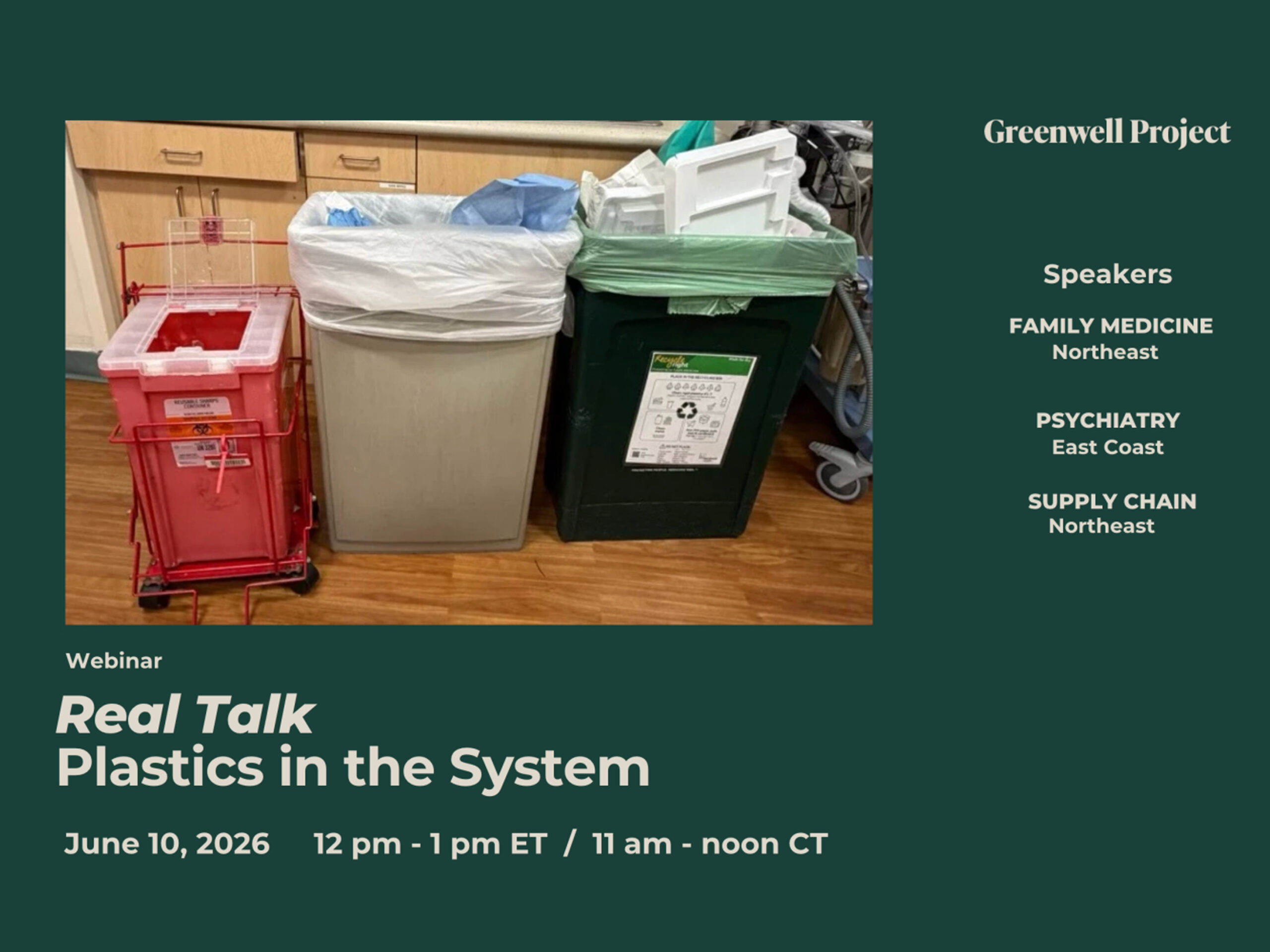
My ability to care for complex critically ill patients at one of my health system’s regional referral centers is made possible by plastic. The practice of Interventional Radiology has benefited from the healthcare plastics revolution of the last generation. Much of the tools commonly used in both routine and cutting-edge procedures are made possible by plastic.
I also recognize that I benefit from this healthcare revolution as well as my patients. Wearing plastic contact lenses for nearly 50 years affords me precise eyesight, allowing me to manipulate catheters and wires measured in millimeters.
The effects of microplastics on human physiology, the plastic waste generated by healthcare and its effect on the environment are a natural byproduct of the advances in medicine. I have found that it is harder to ignore the effects of plastics on people and the environment.
The Scale of the Problem
The healthcare industry is responsible for 7-10% of global carbon emissions (Picano et al., 2022). Radiology is a large contributor due to the high energy use of imaging equipment and the necessity of single-use equipment that is often encased in layers of plastic packaging (Woolen et al., 2023).
Interventional Radiologists pride themselves in being creative problem solvers who apply cutting-edge technology during minimally invasive procedures to improve patient’s quality and quantity of life. When I examined my workplace environment, I recognized that the infrastructure needed to provide care to our patients was part of the problem.
What the Numbers Show
IR significantly contributes to medical waste through high volume of short cases and frequent use of single-use items, many of which include excessive packaging. Single-use disposable medical supplies are the second largest contributor to greenhouse gas emissions in IR suites, accounting for 41% of total emissions (Chua et al., 2021).
In an audit of seventeen neurointerventional procedures in the IR suite, Shum et al. report an average waste generation of 8 kg per case. The procedure with the highest waste burden was coiling, which produced 13.1 kg of waste (Shum et al., 2020).
Even less complex cases, such as central access and ports, generate excess waste. Brassil and Torreggiani found that 12% of PICC set components and 14% of port set components were routinely discarded (Brassil & Torreggiani, 2019). In some cases, additional equipment was used in line with local practices and preferences.
I performed an informal environmental audit of my own practice and realized that my practice was no different.

Following One Patient’s Journey
The impact and problem of plastics is illustrated by examining the journey of one of my patients.
Mrs. X is a 75-year-old female with osteoporosis and multiple myeloma who has a painful fracture associated with tumor within the bones of her spine. She was referred to me to perform a procedure which would strengthen the bone in preparation for spinal radiation. Although radiation would benefit the patient, one of the side effects would weaken the bone and increase her risk for additional fracture that could result in neurologic injury.
The plan was to perform a biopsy to confirm metastatic disease and to gain more tumor material for molecular characterization, to cook the tumor within the bone using radiofrequency energy to decrease tumor burden and pain, and to strengthen the bone with titanium implants and bone cement.
Patient Preparation
My first stop was to our patient preparation area where a plastic IV was placed to administer fluids and medications through plastic tubing from a plastic bag. Blood pressure cuff, heart rate monitor stickies, oxygen sensor, absorbent pad under the patient, and non-slip socks are all plastic.
Inventory and Equipment
After seeing my patient, reviewing her chart, and answering last-minute questions, the next stop was to inventory. Amongst a sea of plastic-wrapped equipment, my technologist and I pulled the needed instruments from our shelves. There were so many boxes and containers that we needed a cart to move it all.

The IR Operating Room
The IR operating room resembles a typical OR with the notable addition of high-tech x-ray and ultrasound imaging equipment which provide us the “eyes” into the body that allow us to perform surgery through tiny needle holes.
The IR suite is a sea of plastic. Plastic covers on capital equipment and computers, plastic anesthesiology oxygen delivery circuit, blue plastic drapes to maintain sterility, plastic instruments, plastic personal protective equipment, the plastic packaging, and it all goes into plastic bags and bins at the end of the procedure.

Recovery
At the end of the operation, the patient proceeds to the recovery room. Recovery completed, the plastic patient care and monitoring items are thrown away.
Although Mrs. X left the hospital with two small incisions, less pain, and prepared for her radiation therapy, she also left with a lifelong plastic souvenir: acrylic bone cement in her vertebra, which can never be removed.
Looking Forward
I am not advocating for us to return to practicing medicine in a plastic-free environment. We should continue to examine the impact of plastics and microplastics on our patients. We should continue to examine why we have succumbed to plastic bloat and to look for alternatives.
One of the driving factors of the move towards single-use items was to decrease the spread of infection during the early AIDS era (National Geographic, 2021). Advances in technology and clinical knowledge afford us the opportunity to examine how we can reduce, reuse, and recycle.
I am confident that the culture of innovation and technology that are the hallmarks of Interventional Radiology can be harnessed to improve patient care as well as resource stewardship.
Sources
- Brassil, M.P., & Torreggiani, W.C. (2019). Recycling in IR, What IR specialists can do to help. Cardiovascular and Interventional Radiology, 42(6), 789-790.
- Chua, A.L.B., Amin, R., Zhang, J., Thiel, C.L., & Gross, J.S. (2021). The environmental impact of interventional radiology: an evaluation of greenhouse gas emissions from an academic interventional radiology practice. Journal of Vascular and Interventional Radiology, 32(6), 907-915.e3.
- National Geographic. (2021). Can Medical Care Exist Without Plastic? https://www.nationalgeographic.com/science/article/can-medical-care-exist-without-plastic
- Picano, E., Mangia, C., & D’Andrea, A. (2022). Climate change, carbon dioxide emissions, and medical imaging contribution. Journal of Clinical Medicine, 12(1), 215.
- Shum, P.L., Kok, H.K., Maingard, J., et al. (2020). Environmental sustainability in neurointerventional procedures: a waste audit. Journal of NeuroInterventional Surgery, 12(11), 1053-1057.
- Woolen, S.A., Kim, C.J., Hernandez, A.M., et al. (2023). Radiology environmental impact: what is known and how can we improve? Academic Radiology, 30(4), 625-630.